Hemant Kumar – Part 4

Hemant Kumar
An unflinching idealist, fiercely committed to bettering his score rather than quantifying his body of work. Hemant Kumar never thrust his vocals on any song. He could have insisted on singing each and every male number that he composed. After all Hemant Kumar was always a name to ‘record’ with! But he chose Kishore Kumar to vocalize the resplendent nostalgia of Woh sham kuch ajeeb thi in Khamoshi while Hemantda stayed in the background for Dharmendra) with Tum pukar lo.
This was typical of Hemantda, Never an attention-seeker either in real life or his musical output, he always wanted his songs to speak for him. Competition never daunted him. In the 50s when Bengal’s matinee idol Uttam Kumar insisted only on Hemant Kumar’s playback, the singer convinced the superstar that Bhupen Hazarika was just right for a particular song in a big budget melodrama. Likewise in Mumbai Hemantda was accepted as Biswajeet’s ghost-voice after the chartbusters in Bees Saal Baad and Kohraa. Still the composer got Mohd. Rafi to duet with the unusual voice of Aarti Mukherjee in the coltish Saara mora kajra, in the film Do Dil, starring Biswajeet.
There were no shortcuts for Hemant Kumar. He couldn’t make creative compromises even if he wanted to because he didn’t know how. His forte was simplicity and honesty of expression. He never cluttered his compositions with orchestral flourishes to camouflage their inherent weaknesses because there weren’t any to begin with.
As a singer Hemant Kumar embodied the search and discovery of perfection through songs like Yaad kiya dilne kahan ho tum, Rulakar chal diye, Log pite hain and Jab se mili tose ankhiyan. Every composition was sung in a style so different and unique that they became cornerstones of subtle romanticism.
Hemant Kumar Mukherjee sang and composed in perfect harmony. To him music was a platform for sincere self expression rather than an occasion to show off or exhibit his knowledge of the nuances of musical styles. A deeply knowledgeable musician erudition sat lightly on Hemantda’s shoulders. For him skill was superseded by accessibility. He forever wanted to reach out to listeners with tunes that they could share. Hemantda sang and composed for listeners from a plane of expression where he was one of the masses. To do this he never had to lower his standards or dilute his talents. Success came naturally to him in whatever he sang or tuned.
The last song that Hemantda sang in Hindi was Aaja mere pyar aaja for R.D.Burman in a comedy called Heeralal Pannalal in 1978. It was a befitting finale to an illustrious but never cheaply flamboyant career. Exactly twenty-five years prior to Aaja mere pyar for R.D. Burman Hemantda had sung his way into singing superstardom for RD’s father S.D. Burman in Jaal.
A success in whatever he tried–singing and composing in Hindi or Bengali–Hemant Kumar was a far more talented versatile and skilled musician than we can ever imagine. When we listen to Hemantda singing Chandan ka palna with Lataji or composing an enigmatically enriched tune like Hawaaon pe likhdo for Kishore Kumar we are forced to conclude that in order to be a brilliant creative artiste one must first be a good human being – Subhash K Jha
 ABOUT THIS AUTHOR
 Cineplot Cinema & Films
 Cineplot Photo Gallery
 Surinder Kaur's Hindi Song List
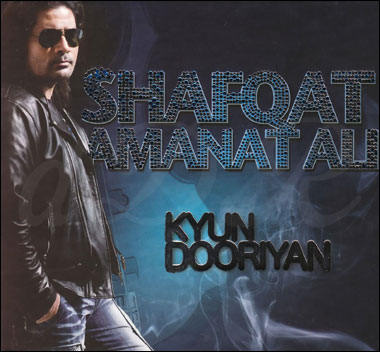 Album Review - Kyun Dooriyan by Shafqat Amanat Ali Khan
 Suraiya's Filmography
 Kishore Kumar's Song List (1956 - 1960)
 Ijaz Hussain Hazarvi
Reply