Lata Mangeshkar – Sajjad Hussain Collaboration
____________________
Back to Legends – Lata Mangeshkar
____________________
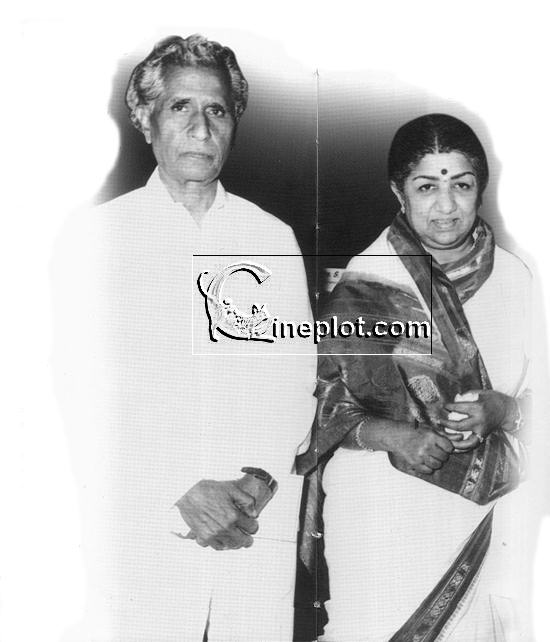
Sajjad Hussain with Lata Mangeshkar
Sajjad Hussain was known as the only original composer of Hindi cinema. His compositions rank amongst the most complex scores of Hindi film music. Known for his forthrightness which resulted in many tussles and controversies, he ended up doing only 14 films and less than 100 songs in his 20 years long film career spanning from Dost (1944) to Rustam Sohraab (1963).
He composed only 14 songs [13 solos and 1 duet] for Lata in 6 films, but each and every one of those songs could be considered a musical masterpiece ranking among Lata’s best.
Sajjad Hussain on Lata
I was composing music for a film called 1857. The Hindustani title of the film was Gaddar. We were rehearsing in a production office on the fourth floor of a building, and Latabai’s guru, Amanat Khan Devaswale, happened to give singing lessons on the third floor. We were friends and visited one another. One day he said: `Sajjad Sahib, I have a disciple, a girl, so gifted by the grace of Allah. She is so intelligent and so incredibly musical, a kind of musical genius. No matter how difficult the piece she sings it at once. Every night I think of another intricate exercise to teach her — sing this sargam, or taan or murki in a particular way — and she sings it. She sings everything effortlessly. Now I am so worried. Allah, what can I ask her to sing next?’
I was amazed to hear him say this because Amanat Ali Khan, a fine singer himself, never praised anyone. He had a very complex nature. He was a recognized master and had a big name, and for him to speak in this way was most out of character. So I thought to myself, one day I must ask his young disciple to sing for me.
In 1950, I was working on K. Asif’s Hulchul. It had a fine cast with Dilip Kumar and Nargis. It was the first time I called Latabai for a rehearsal. I explained the song, `Aaj mere naseeb ne’ to her. She is very intelligent and thought about it carefully and then sang. I was pleased with the rehearsal and the song was recorded.
As it happened that particular song was deleted from the film. The producers finally gave it to another company. I didn’t complete Hulchul because they hadn’t paid me. Perhaps someone else finished the film. But I did compose three songs for the film: a mujra, and two other songs by Latabai, which included `Aaj mere naseeb ne.’ Sometime later, I heard `Aayega aanewala’ from Mahal. I think it was Khemchand’s song. That’s when I thought to myself: `Amanat Khan Devaswale was absolutely right. This girl is bound to be a brilliant singer one day.’
The quality and purity of her voice, presentation, performance, sureelapan, the way she feels the words and tries to give a sense of what the words mean – these are her talents.
Thanks to Allah, I was very happy to have found such an elegant singer. And I decided that whenever I needed a singer, my first condition would be:
`I will only sign the contract if Latabai sings or else I won’t.’ Filmmakers are always in a tearing hurry, and if only I happened to have no other choice, did I use another singer — say if she was unwell and couldn’t come to the recording. I always asked her to sing my songs, whether it was for a big or small film. I could see no singer better than her. If they had existed, they would be visible. Good singers cannot be hidden.
The most important thing in music is `sur.’ Music is nothing without tunefulness. If someone sings out of tune, then the musical value of a song is nil. Whether classical music, film music, a ghazal or a bhajan — she sings everything perfectly in tune.
Great Hindu and Muslim classical singers, classical musicians, and laymen say she sings without compare. Other playback singers and people who know how to appreciate good music, all say the same thing. And without doubt, she is without compare. No one can equal her intelligence. Nor can anyone equal her simplicity. She has such grasping power — and understands a song like no one else.
Anyone who sings without really understanding the words cannot feel them. How can they? That is why she decided to learn Urdu and made sure she pronounced and understood all the difficult words. She understands good poetry and just how intoxicating words can be. Once you know the word meanings, they penetrate the heart.
Everyone wants to listen to a good singing voice. That’s why music-lovers have no choice but to admit that Latabai is without compare. That’s how I understand it.
Lata on Sajjad Hussain
Nasreen Munni Kabir: Were there any music directors you found difficult to please?
Lata Mangeshkar: At the beginning there are difficulties with everyone. I was always apprehensive when I sang for Sajjad Hussain Sahib because he was very particular. He never liked loud singing. Sometimes an alaap is sung rather loudly — he didn’t like that. He insisted all the musical instruments were perfectly tuned. He played the mandolin extremely well and if a single musical instrument was slightly out of tune, it displeased him. Compromising was not in his nature.
I often wondered when I sang for him: ‘Will he like it? Am I singing correctly?’ But I always wanted to work with him. Even now when you hear his songs, though the verses are sung in a high octave, they sound effortless. They aren’t painful to hear, nor do they sound as though they were strenuous for the singer. This was his approach and I found it a little difficult. (Source :- Lata Mangeshkar …in her own voice by Nasreen Munni Kabir)
Lata – Sajjad Collaboration
Lata sang 14 songs for Sajjad Hussain, details are provided below :-
| Song | Year | Film | Co-Singers | Music Director |
| Bhool ja aye dil mohabat ka fasana | 1950 | Khel | Sajjad Husain | |
| Jate ho to jao hum bhi jahan waadon ke sahare | 1950 | Khel | Sajjad Husain | |
| Aaj mere naseeb ne mujhko rula | 1951 | Hulchul | Sajjad Husain | |
| Loota dil mera haye abaad ho kar | 1951 | Hulchul | Sajjad Husain | |
| Hawa men dil dole machal kar bole | 1951 | Saiyan | Chorus | Sajjad Husain |
| Kali kali raat dil bada sataye | 1951 | Saiyan | Sajjad Husain | |
| Khayalon men tum ho nazaron men tum | 1951 | Saiyan | Chorus | Sajjad Husain |
| Kismat men khushi ka naam nehin | 1951 | Saiyan | Sajjad Husain | |
| Tumhe dil diya yeh kya kiya | 1951 | Saiyan | Sajjad Husain | |
| Woh raat din woh shaam ki guzri kahaniyan | 1951 | Saiyan | Sajjad Husain | |
| Dil men sama gaye | 1952 | Sangdil | Talat Mahmood | Sajjad Husain |
| Woh to chale gaye aye dil | 1952 | Sangdil | Sajjad Husain | |
| Tera dard dil men basa liya | 1955 | Rukhsana | Sajjad Husain | |
| Ae dilruba nazrein mila | 1963 | Rustom Sohrab | Sajjad Husain |
 ABOUT THIS AUTHOR
 Cineplot Cinema & Films
 Cineplot Photo Gallery
 Talat Mahmood's Song List (1956 - 1960)
 Hamida Bano
 Saeen Ditta Qadri
 Lata Mangeshkar - Profile
 Mohammad Rafi - Part 3
(add)- One Comment
- Trackbacks/Pingbacks