S.D. Burman (1906 – 1975)
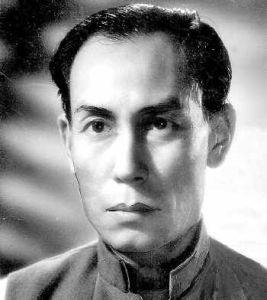
S.D. Burman
Soft melodies, aromatic of the loamy soil of Bengal, remained S D Burman’s trademark till the last. After composing soothing harmonies for 40 years, Dada Burman proved that age is no impediment for creativity. The only great composer to be active and in demand till the end, S D Burman had just released successful scores in films like Jugnu, Chupke Chupke and Abhimaan in the mid-70s before he slipped into a coma.
Sachin Dev Burman’s early life was infused with music. Born into the royal family of Tripura, he began his training in classical music under his father. The sensitive Burman surmounted early reverses in his career as a singer and soon became a celebrated music director in Bengal’s cinema. His decision to move to Bombay with the Ashok Kumar starrer, Eight Days (’46) was seen by many Bengalis as the obliteration of his creative genius. However, with the Do Bhai (’47) song `Mera sunder sapna beet gaya’, Burman exhibited that his talent could prosper on the rocky terrain of Bombay too.
But within a couple of years, disillusioned with the blatant materialism of Bombay, Burman deserted the Ashok Kumar starrer, Mashaal, halfway and decided to board the first train to Calcutta. Fortunately, friend dissuaded him at the last moment for gems like Vaqt ne kiya’, `Gaata rahe mera dil’and `Mere sapno ki rani’ would have otherwise remained locked in Burman’s creative vault forever.
Dev Anand’s Baazi (’51) marked Burman’s ascent to the top and the beginning of a long association with Navketan. Simply structured yet beguiling songs like `Tadbeer se bigdi hui’, `Jaayen toh jaayen kahan’ or `Chhod do aanchal’ became Burman’s forte. In fact whenever his assistant, Jaidev, composed intricate classical numbers, S D Burman would reprimand him saying, “My songs should be hummed even by my servant at home.”
Even in the face of the heavy orchestration resorted to by Naushad, C Ramchandra and Shankar Jaikishen in the 50s, Burman continued to spin light melodies (`Aaja pancchi akela hai’ or laane kya to ne kahi’) using only a few Indian musical instruments. Impressed by his mastery, famous directors like Guru Dutt (Pyaasa, Kagaz Ke Phool) and Bimal Roy (Sujata, Bandini) consistently worked with him.
Ill health and a temporary squabble with Lata Mangeshkar caused a slump in his career in the early 60s but his superlative compositions for Guide (’65), Jewel Thief (’67) and Aradhana (’69) showed that S D Burman could still dictate trends.
Occasionally, Burman lent his sonorous voice to the theme songs of films like Bandini (`Mere saajan hai us paar’), Guide (`Wahan kaun hai tera, musafir’) and Aradhana (`Safal hogi teri aradhana, kahe ko roye’).
Burman was 62 when he composed the score for Aradhana. Competing with son, Rahul and other westward looking music directors, S D Burman continued to enthrall audiences with Indian music in films like Sharmilee (’71) and Abhimaan (’73).
S D Burman’s death in 1975 marked the end of the last phase of the golden age of melody.
 ABOUT THIS AUTHOR
 Cineplot Cinema & Films
 Cineplot Photo Gallery
 Noor Jehan - Datta Korgoankar Collaboration
 Suraiya’s Song List (1941 – 1950)
 Talat Mahmood's favorite songs from his career
 Legends - Talat Mahmood
 Kishore Kumar's Song List (1946 - 1950)
Reply