Raj Kapoor – The Social Reformer
____________________
Back to Legends – Raj Kapoor
____________________
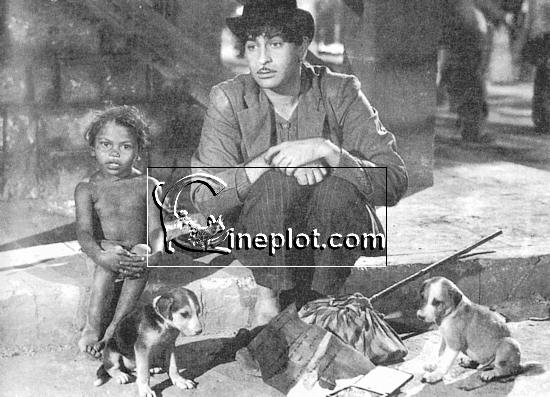
Raj Kapoor in Shri 420 (1955)
What is Raj Kapoor’s precise contribution to films? He saw his protagonist as an ingénue. His Raju (played by himself) was always forced into wrong-doing or was an innocent victim of society’s wrong attitudes. Yet his sheer innocence, exuberance, optimism and inherent goodness as it were, gave him simple joy in the smallest pleasures of life. Too simplistic, one might say, and could be carried too far at times. But it was an appropriate vehicle for what he was trying to convey and it worked with the masses.
In Shri 420, he explored the dilemma of the common man. The title suggested that the hero is forced to become a gentleman conman because society does not allow honest men a living. This film was definitely a progression over Awara and more complex in its treatment. If Awara showed the hero as a simpleton, in Shri 420 he was an educated youth, looking for work till he discovers it is easier to make money if he is not carrying the baggage of values and principles.
But Raj Kapoor’s penchant for seeing even real issues through the pink-tinted glasses of sentimentality gave this film too a resolution which culminated in an emotional ‘all’s well that ends well’. His hero even after deciding on a life of ‘easy money’ still has a heart of gold. The song Mera joota hai Japani shouted this out for all to hear. Nobody was to conclude that the protagonist was past redemption even though he does have lapses as expressed in the song ‘Mud mud ke na dekh mud mud ke’.
This ’420′ was adorable — his friendship with the pavement dwellers, his sense of belonging to an environment where the street dog and the poor man can share their space and food, made him almost an icon in Hindi cinema. The symbolism of the hero and a mongrel sharing the sidewalk, made people cry where Raj Kapoor wanted them to and he had the entire country eating out of his hands.
In the post-independence era, the country required large gulps of emotional sentimentality and Raj Kapoor had correctly felt the pulse of his audiences. Not too much taxing of the brain, good music, simple themes which went straight to the heart and he had not only a hit film on his hands but one which in its own insidious way makes a statement even in this age of computers. His ‘Ramaiyavastavaiya maine dil tujhko diya’ suggested once more that it required only love to change the social order and bring it to rights.
Interestingly, Shri 420 was saying all this in the guise of comedy — it remains one of the better comedies in Hindi films. The scenes where he woos Nargis with a cup of tea but brazenly asks her to pay for it because he has only Rs.100 notes, remains a scene where in pure RK tradition, you have to laugh and cry at the same time. The number ‘Pyar hua ikrar hua hai’ became an anthem, the scene where the two leading actors walk in the rain sharing an umbrella – is a never-to-be-forgotten visual.
The happy-go-lucky tramp then appeared in Anari, and inspired Jis Desh Mein Ganga Behti Hai, where Raj Kapoor as the simple villager sets out to reform dacoits. He believes that they are actually socialists who are balancing the world by making the rich a little poorer and the poor a little richer till he discovers their unnecessary violence. Chhalia again showed Raj Kapoor as the reformer — this time around seeking to build a spirit of unity between the Hindus and Muslims. This theme was continued in Henna, Abdullah and Khan Dost.
Sangam was Raj Kapoor’s first color film dealing with the most popular of Hindi film themes — the love triangle. Since it was Raj Kapoor, there had to be a moral inherent even here. The alternation between tradition and modernity, between the sanctity of marriage and the ideals of friendship and sacrifice, as well as love for one’s country, all showcased Raj Kapoor the idealist at his very best.
Kal Aaj Aur Kal — an ambitious film showing three generations represented by Randhir Kapoor, Raj Kapoor and Prithviraj Kapoor was lapped up by audiences, once again as a RK product. Raj Kapoor plays the present generation sandwiched between the traditions of the past and the desires of the future generation. As he tries to maintain a balance between grandfather and grandson, he enacts a role that becomes both comic and a little priest-like as he hammers across the relative virtues of both the past and the future generations.
The role of the tramp culminated in his biographical blockbuster Mera Naam Joker, an ambitious project by any standards. It was a long film with two intervals, took six years to make and was divided into three stories. Raj Kapoor put everything he possessed into this film, both financially and emotionally. And played the title role himself. The lovable tramp was submerged into the gallant joker who keeps laughing at life’s injustices, while his heart bleeds. Audiences knew they were watching something real here. Yet the film failed. Raj Kapoor was broken. He couldn’t believe that his midas touch had deserted him this time. Joker remains the only film made by Raj Kapoor that bombed at the box office.
After this he made a quickie Bobby, which became an instant hit. So did his subsequent films. But now Raj Kapoor had started taking recourse to sensuality and all films like Satyam Shivam Sundaram, Ram Teri Ganga Maili, Bobby played to the gallery, in terms of exposing the female body. But again before anyone could point fingers at this, they had to admit that Satyam Shivam had a beautiful theme too — and in Ram Teri Ganga Maili, his Ganga was the epitome of all that is good and pure in this country. Just as his tramp image ended in Joker, his vision of what a beautiful woman represents culminated in Ganga. In Prem Rog he was making a conscious statement about liberating women and all these films succeeded; for from this filmmaker people expected some social message too – Lata Khubchandani
 ABOUT THIS AUTHOR
 Cineplot Music
 Cineplot Photo Gallery
 Ganga Jamna (1961)
 Bollywood - Sanjay Dutt's new challenge!
 Indian Film Database - 1972
 Mumtaz
 S.M. Yousuf
Reply