Saath Laakh (1957)
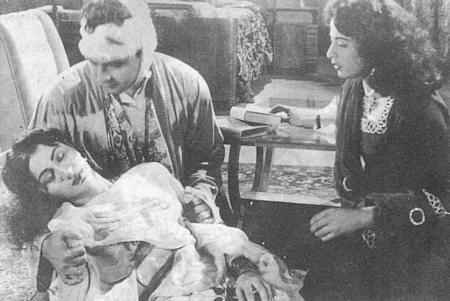
Nayyar Sultana, Santosh Kumar, and Sabiha Khanum in Saath Laakh (1957)
Saifuddin Saif, a poet turned film maker, produced Saath Laakh, an unusual social drama with all the ingredients of a masterpiece, barring the inadequate sets which were more indicative of a paucity of funds rather than a slur on the director’s imagination. The film can be categorized in the genre of Frank Capra’s comedy of social comment, e.g. Mr Smith Goes to Washington. Saath Laakh begins with a young, smart and spoilt girl (Sabiha Khanum) who is to inherit her deceased father’s immense wealth (seven lakh rupees in cash, the bungalow where she lives which is also worth seven lakhs and seven lakhs in lands and real-estate) on condition that she settles down to a married life.
Her parents had a very unhappy married life and as such she abhors the very idea of marriage. On the assumption that he will be her husband, her cousin (Himaliyawala) adopts an extravagant lifestyle sustained by borrowing money. She dislikes the man and keeps him at a distance. In order to fulfill the legal requirements of the will, she consults her father’s lawyer (grossly over-acted by Asif Jah) and comes up with the novel idea of marrying a person who is terminally ill and about to die. The lawyer is shocked to hear such a wily plot but gives in on the grounds that the proposition does not violate the legal framework of her father’s will, and therefore sounds all right. Together, they search the city’s hospitals and find a very sick man who, according to medical experts, is on his deathbed. They make a deal and the man aggress the heiress in return for financial support for his mother. The sick man then bemoans the irony of fate! All through his life he longed to have a wife but couldn’t get one because of his poverty, and now, a beautiful and rich girl offers herself to him when he is on the verge of death. There is an element of black humor in the scene when the man dies before the qazi can solemnize the ceremony.
The disappointed heroine then comes across another victim of circumstance. A tall and handsome man (Santosh Kumar) is running away from the police, and finds refuge within her palatial house. He had killed a man accidentally and now asked her for shelter, the heroine offers him safety on condition that he weds her then and there. He agrees and a qazi is dragged out of bed to perform the nikah ceremony at midnight, in return for a handsome fee. Early next morning, before the couple leaves for the bride’s hill-station bungalow, she instructs her lawyer to fetch the police on a certain day so that she is able to rid herself of her husband of convenience. Santosh soon discovers that his wife refuses to share any physical intimacy with him. Despite this humiliation he does not react violently but in fact starts avoiding her altogether. Finally, he resolves his inner conflict be deciding to turn himself in to the police instead of continuing with their estranged relationship. She ultimately learns to appreciate his honesty and dignity but it is too late. The police arrive and, in spite of her best efforts, she can neither prevent his arrest nor apprise him of her change of heart and intent.
The story further unfolds to reveal how, in order to rescue a prostitute (Nayyar Sultana) from a potential killer, the hero pushes the villain and the man dies by falling on his own knife. The girl from the brothel thus stands witness to his innocence in court, defying threats and the lure of money.
In contrast with a well-bred woman, who cannot survive without her father’s wealth, a prostitute, who earns for herself and others, emerges as a better person from every angle. Yet in the end she must die to pave way for the happy reunion of the bourgeois couple. Perhaps real life is like that.
The music by Rashid Attre stands as the highpoint of the film. The song Aaey mausam rangile suhane tu chutti le ke aaja balma! (Spring is upon us with riotous colors. Come! Take leave from work my love) picturized on the young bit player, Neelo, captivated a great number of film-goers and made her known all over the country. This was the beginning of Neelo’s long and illustrious career. She was Pakistan’s first oomph girl. Similarly, Talish’s performance as a drunkard singing Yaro mujhe maaf karo, main nashe main hun earned him many roles thereafter. Nayyar Sultana, a struggling actress, gave a powerful and convincing performance. Santosh proved her mettle as an accomplished actor in executing a low-key enactment of an honest man. Sabiha came across as coquettish and superficial as per the need of the character she played in the film. Saath Lakh, directed by Jaffar Malik, was rated the best film of the year and received the first Nigar Award trophy at its inaugural ceremony in 1958 – Mushtaq Gazdar
Cast and Production Credits
Year – 1957, Genre – Drama, Country – Pakistan, Language – Urdu, Producer – Saifuddin Saif, Director – Jaffer Malik, Music Director – Rashid Attre, Cast – Sabiha Khanum, Santosh Kumar, Asif Jah, Neelo,Talish, Nighat Sultana and Nayyar Sultana
 ABOUT THIS AUTHOR
 Cineplot Music
 Cineplot Photo Gallery
 Heer Ranjha (1970)
 Pakistani Film Database - 1948
 Neela Parbat (1969)
 Kareena Kapoor - Latest Interview
 Turkish Cinema – Expanded cinema fest to kick off in Turkey’s Datça
Reply