Amar Jyoti (1936)
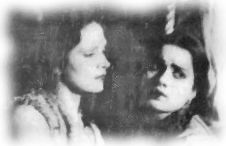
A scene from Amar Jyoti
Like many of the Prabhat films directed by V. Shantaram, “Amar Jyoti” or “Immortal Flame” made in 1936, had many news goals to its credit. It had a theme and purpose that were much ahead of its times. In its technique and treatment, it marked another important milestone in the evolution of India Cinema. It was one of the earliest Indian films to participate in an international film festival (at Venice) and win praise. And it also proved a highly successful film with Indian audiences all over the country, despite the heaviness of its thematic ideas and conflicts, the slow rhythm with which it moved and the lack of entertaining features in it.
The film was laid in an ancient period, with a semi-costume background of a queen and her cruel Minister, who are challenged by a woman turning a pirate and terrorizing the coastal provinces of the ruler. This woman, Saudamini, has been much wronged by her husband. But when she went to plead for justice, the Minister Durjaya decreed that a husband was the complete master of his wife, whom he could ill-treat, use as a chattel or dispose of as a slave. This greatly enraged her against the two sexes and drove her to revolt and seek revenge, by herself becoming like a man and getting into a commanding position, as the captain of the pirates.
Durjaya was caught and kept as a captive with one of his legs cut off, to make him realize the eternally enslaved condition of women. Her next big catch was the queen’s daughter. But here, she played an even bigger game by converting the princess to her creed of female emancipation, which considered love and marriage as a bondage. The princess suppressed her feelings for a shepherd boy, whom she had met during her days in the pirate’s den but who was actually the son of Saudamini, separated from her years ago. Then Durjaya got himself free and also arrested Saudamini, taking the drama to its climax. The film ended with Saudamini’s mission being carried on by other and one symbolic flame lighting the flames in many other hearts.
Shantaram used the symbol of the lamp and the flame and many other techniques that were considered new for the time. But the film’s real success was in bringing out the inner conflicts of women, who may become male-like rebels, only at the cost of suppressing their natural urges as wife or mother. The most moving sight was of Saudamini secretly fondling the tiny garments of her child. Durga Khote played the role with a lot of verve aided by little Vasanti as her rebel heir. Shanta Apte, who played the soft princess, was soon to don the real rebel garb in Shantaram’s first social “Duniya na Mane”. Nandrekar made a really muscular and manly hero and his romantic scenes in the woods with Shanta Apte had a fantasy air. Another unforgettable role was of Chandramohan as the lame and beastlike captive Durjaya. But if the film had a totally wrong element, it was in the dozen of more songs cropping up here and there and disturbing the flow – C.D.
Photo Caption – Durga Khote and Shanta Apte
Cast and Production Credits
Year – 1936, Genre – Drama, Country – India, Language – Hindi, Producer – Prabhat Film Company, Director – V. Shantaram, Music Director – Master Krishna Rao, Cast – Durga Khote, Chandramohan, Shanta Apte, Vasanti, Nandrekar, K.K. Kale
 ABOUT THIS AUTHOR
 Cineplot Music
 Cineplot Photo Gallery
 Ghoonghat (1962)
 Indian Film Database - 1951
 Iranian Cinema - Iran Director Banned From Travelling to Venice Fest
 Bollywood - Year by Year - 1956
 Tahmineh Milani (1960 - )
Reply