C.H. Atma
____________________
Profile | Song List
____________________
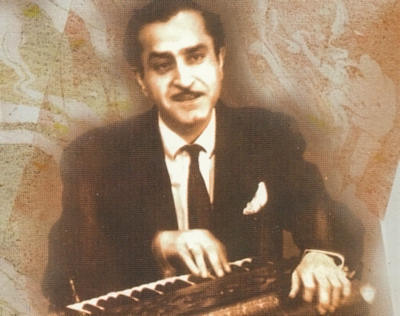
C.H. Atma
“Dukhiya jiya bulaye, preetam aan milo…” The call of the wounded heart became the anthem of young lovers of the ‘50s who dared to fall in love and suffer the consequences.
Such an aura of daring always surrounded the late C.H. Atma’s selective but luminous contribution to popular music. A loyal follower of the legendary Kundal Lal Saigal, Atma belonged to the elite circle of singers who stepped into the realm of popular Hindustani music in the 1950s, armed with their dreams and their irrefutable Saigelesque credentials.
This small band of singers included the shortlived Master Madan, the baritoned Habib Wali Mohd, the evergreen Mukesh, and last but decidedly not the least, C.H. Atma who continued to be distinctively Saigelesque even after establishing himself as a singer of repute and right upto his premature demise.
Though Atma’s precise crystal-clear rendering was a salute to Saigal’s style, he also went his own way to discover and create a haven of hushed harmonies. Succeeding in gathering a strong and ardent band of fans who loved his voice in both his film and non-film repertoires. In fact, Atma is perhaps one of the few whose career as a film and non-film singer flourished simultaneously. If on the one hand he infused a kaleidoscope of feelings in a film song like “Yeh raat din ka phera”, he breathed life into non-film nugget like “Kehne ko bahut kuch”. O.P Nayyar kindled the Diwali spirit in Atma’s enormously evocative “Mein ghee ka diya jalaoon”, a non-film song. While getting the best out of Atma in “Iss bewafaa jahan mein”, for the film Aasman.
Aasman was adorned by three Atma solos “Raat suhani hanste tare”, “Kuch aur samajh nahin aye”, and of course, “Iss bewafa jahan mein”. Directed by the prolific producer Dalsukh Pancholi, Aasman had the distinction of being composer O.P. Nayyar’s first independent assignment. It is no co-incidence that the two selected Atma to render all the male vocals. If all had gone well, Atma would have succeeded in bringing together Nayyar and Lata Mangeshkar for Aasman. For Atma and the melody queen were mutually bonded by their love for K.L. Saigal’s singing.
“Preetam aan milo”, which was O.P Nayyar’s passport into moviedom is also the number by which Atma is most fondly remembered by his fans. His singing has an unrestrained and seamless quality that goes beyond mere technical excellence. Emotions are fanned, fuelled and set afire in Atma’s numbers making the listener feel like he or she has heard life’s most impassioned pleas in the form of a song.
So heavy and pensive was Atma’s singing that composers seldom used his voice for lighthearted songs. While Saigal defined the defeatism of the pre-partition era, Atma was the voice of a nation peering through the post-Partition desolation into optimism. Effortlessly characterizing the hopefulness of a people in chaotic transition. While there may be pessimism in Atma’s renderings, he doesn’t leave listeners hopeless. Instead he adds a unique dimension to the scenario of each number.
It goes to Atma’s credit that he could infuse a timelessness to compositions by every tuning maestro, from the largely popular O.P Nayyar and Shankar-Jaikishan to the lesser known, though equally gifted, Ninu Mazumdar and Ramlal. A producer like Dalsukh Pancholi and director like Ravindra Dave repeatedly relied on Atma to lend a dimension to their movies. In Dave’s Nagina and Bhai Saheb for instance, composers Shankar-Jaikishan have made the most of Atma’s critical consistency and marvelous enclaves of emotions for “Raat phagun chand poornima ka” (Bhai Saheb) and “Rowoon mein sagar ke kinare” (Nagina).
From singing a romantic number like “Hazaroun gham diya tumein”, in a non-film album for composer Kersey Mistry in 1970 to imparting life into Omar Khayyam’s Rubaiyat in “Ek pal jo mila hai tujhko”, (for composer Ramlal, in Geet Gaya Pathoron Ne – Atma’s last film), the singer unconsciously built a world of supple romance and sensuous splendor that remains alive and vivid even today – Sanjeev Kohli
Listen!
Preetam aan milo, Music – O.P Nayyar, Singers – C.H. Atma, Film – Non Film Geet
Listen!
Roun mein sagar kai kinare, Music – Shankar Jaikishan, Singers – C.H. Atma, Film – Nagina, Year – 1951
 ABOUT THIS AUTHOR
 Cineplot Cinema & Films
 Cineplot Photo Gallery
 Talat Mahmood's Filmography
 Suraiya's Factfile
 Hemant Kumar - Part 4
 C.H. Atma Song List
 Lata Mangeshkar's Song List - 1952
(add)- One Comment
- Trackbacks/Pingbacks